





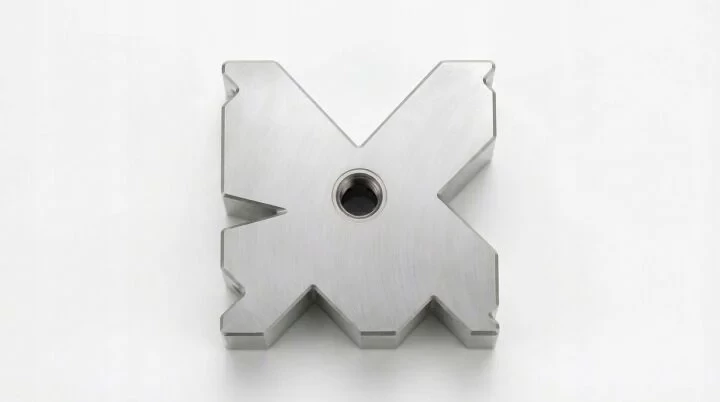
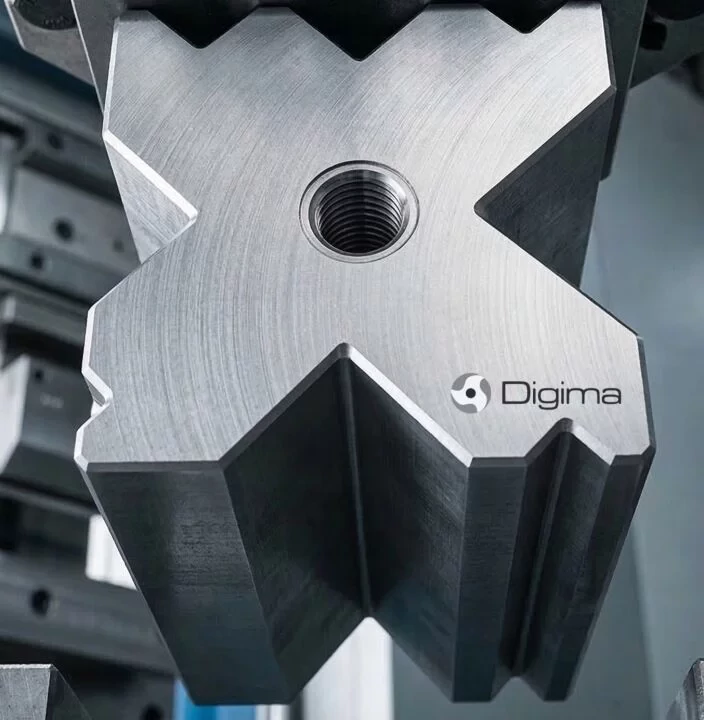


Digima prism die for AMADA press brake, 95x95x2500 mm, 100T, 125T, M16


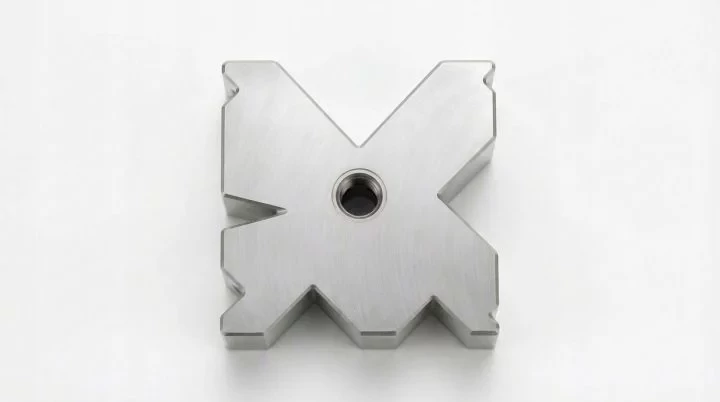
Digima multi-groove prism die for an AMADA press brake, 95x95x2500 mm, 100–125T
We are pleased to present a professional four-sided die (multi-groove prism) from Digima, designed for heavy-duty use on press brakes compatible with the Amada system. Following a detailed review of the technical documentation, we can confirm that the models designed for 100-tonne and 125-tonne machines are structurally identical. This means that the tool we offer guarantees the same precision and durability across both tonnage ranges, providing a versatile solution for advanced metalworking facilities.
The die features a four-sided design with a side length of 95 millimetres, which translates into exceptional rigidity and resistance to deformation under load. Thanks to its multi-slot design, the operator has a choice of different V-channel opening widths, enabling the machine to be quickly adapted to a specific task without the need for time-consuming changeovers. Each channel has been precision-finished by grinding to ensure repeatable bending angles along the entire 2,500-millimetre length of the tool.
Compatible with the PBH-100-2500, PBH-125-2500 and other presses of these dimensions
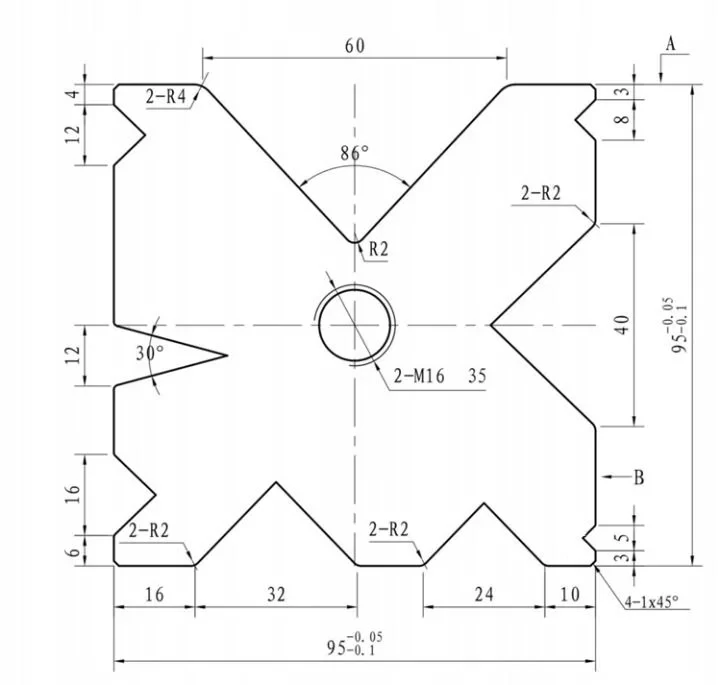
Technical parameters and design specifications
Below is a detailed summary of the technical specifications for the multi-row die, compiled directly from the design documentation:
Overall and installation dimensions:
- Total length of the tool: 2500 millimetres.
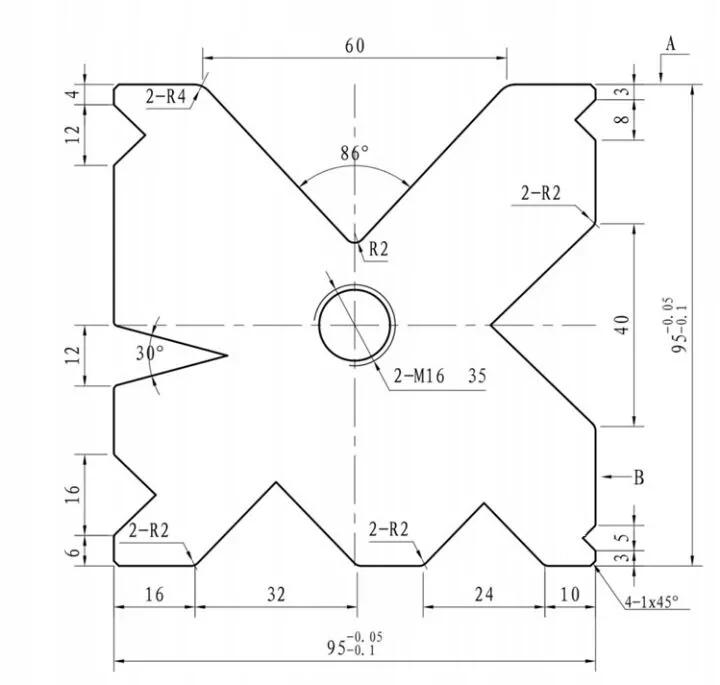
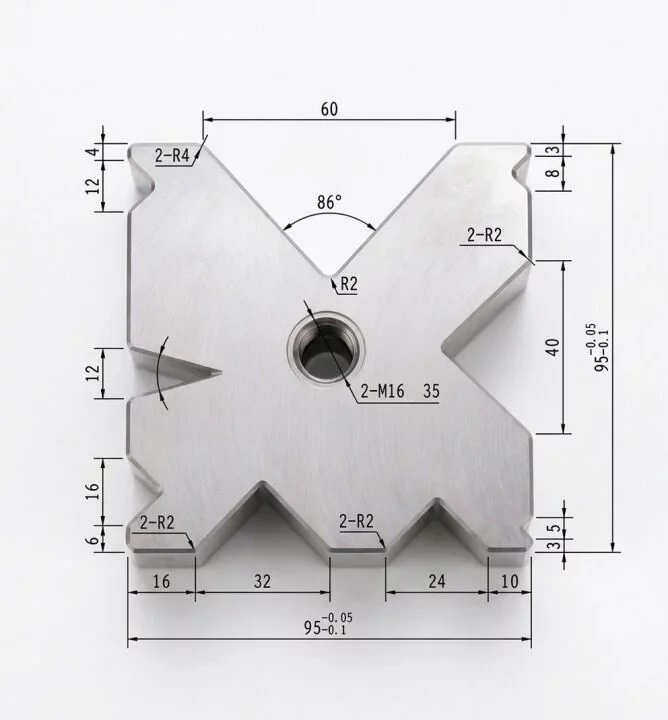
- Cross-section of the body: a square with a side length of 95 millimetres.
- Tolerance on the external dimension: 95 millimetres, with a deviation ranging from minus 0.1 to minus 0.05 millimetres.
- Clamping system: the tool is fitted with two holes for M16 bolts, 35 millimetres deep, ensuring stable mounting in the press die.
Geometry of working channels and V-grooves:
- V-opening widths (selected channels): the die offers a wide working range, including a large opening of 60 millimetres and smaller channels measuring 32 mm, 24 mm, 16 mm, 12 mm and 10 mm.
- Bending angles: for most grooves, the standard angle is 86 degrees. The die also features a specialised groove with an acute angle of 30 degrees.
- Lead edge radii: depending on the channel, working radii of R4 (for the largest groove) and R2 for the others have been used, which prevents the material from cracking during bending.
- Processing undercuts: relief channels (tool exits) measuring 2 by 2 millimetres have been machined into the bottoms of the working channels.
Standards of precision and finish
- Manufacturing precision: the error in parallelism and straightness of the die along its entire length does not exceed 0.05 millimetres.
- End edge machining: sharp edges at both ends of the die have been chamfered with a safe 5-to-45-degree chamfer.
- Other roundings: all radii not specified in the drawing are R 0.5 millimetres.
- Body chamfering: the outer edges of the tool are finished with a 1-degree chamfer at 45 degrees at four points along the profile.
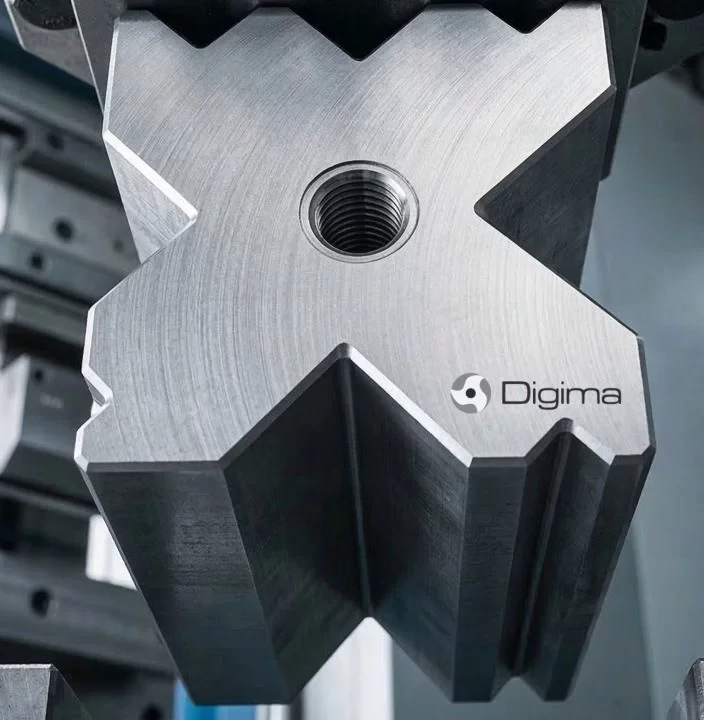
*The photographs are for illustrative purposes only; the main image shows the cross-sectional shape of the tool as depicted in the technical drawing (without indicating the length), whilst the side view provides an example of how such a segment would appear in reality